

So you’ve decided to sell your artworks – great, that’s a big step! But an important question is looming in your mind: how much should I price my art?
Like all budding artists, you might wonder how to establish a price that is fair both to you and your potential buyers. Setting the price of your first artworks correctly is an important step, as it will determine the price of your next creations.
Although there are no universally accepted rules regarding the pricing of artworks, all agree that it is preferable to find a scale or formula to apply to all of your artworks. As you will see, many factors influence the value of an artwork.
THREE FORMULAS TO DETERMINE PRICES
An artwork’s price is usually determined based on its dimensions and the mediums used. Here are 3 methods that can be used to set the price of your creations:
Square inch
This method ensures a regular price proportional to the size of your works. All you need to do is to multiply the artwork’s height by its width, and to multiply the resulting product by a fixed price.
Linear inches
If you sell works of varying dimensions, the previous technique might not be appropriate for your needs, as small works will be quite inexpensive, whereas larger works might become too expensive for your clients. You can therefore use the linear inches formula: instead of multiplying the work’s height and width, add them together and multiply their sum by your fixed price.
Hourly rate
It is also possible to bill based on the time required to complete an artwork. This technique is less common and can result in unstable pricing from one creation to another. However, calculating the average time spent on your artworks might help you establish your square inch or linear inches set price. What “wage” would you give yourself to attain your financial goals?
SIX FACTORS INFLUENCING AN ARTWORK'S VALUE
The methods listed in this guide are fairly simple and allow you to quickly calculate the cost of new creations. The real challenge is to establish the fixed price’s value. To choose this amount, you have to consider the following criteria:
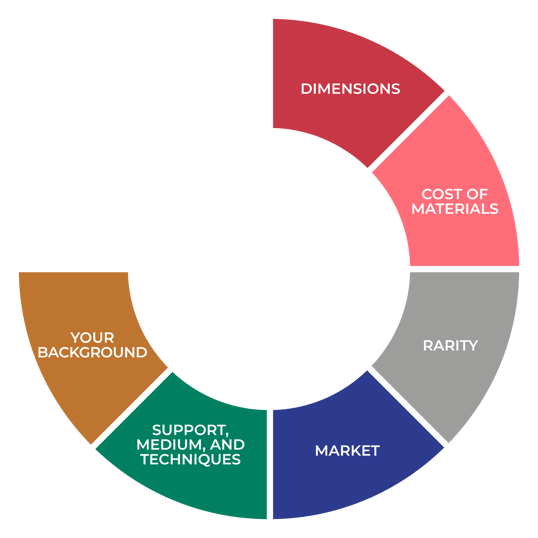

Dimensions: As previously mentioned, the artwork’s dimensions and the time invested into its realization play an important role in its value.

Cost of materials: You can add the cost of materials to your formula or include it to your fixed price. It goes without saying that a sketch on paper does not entail the same expenses as a bronze sculpture for instance. Don’t forget to take into account related expenses such as framing, if applicable, or packaging and delivery

Rarity: If your artwork is unique, it will have a greater value than if it is reproduced in several editions. Moreover, a limited series of prints can be sold at a higher price than an unlimited one.

The market: In which market do you wish to evolve? Who is your ideal client? What is their budget? How much do similar artworks sell for? A selling price is influenced by context, offer and demand. It is necessary to conduct research in order to get a better understanding of the people susceptible to buy your artworks and of other artists evolving in the same milieu.

Support, medium, and techniques: Some techniques, due to their history or complexity, are more valued than others. Hence, following the two-dimensional artwork hierarchy, oil painting comes first, followed by acrylic, then by works on paper (watercolour, pastel, charcoal, etc). Accordingly for sculptures, marble supersedes clay. If you practice various techniques, set a price for each of them. If you create digital artworks or photographs, you can offer prints on various mediums (e.g. cardboard, aluminium, canvas). Of course, the cost and durability of the chosen option will influence the work’s sale price.

Your background: Eventually, your progression and your renown (number of exhibitions, awards received, etc) will add value to your works.
THREE GOOD PRACTICES
Here are some general tips to keep in mind when setting your prices:
- Searching similar artworks
To help you set the right price, compare your works to that of other artists. Take into consideration their career advancement, the mediums used and the subjects depicted.
- Progressively increasing prices
You can increase your prices progressively over the years if your artworks seem to sell well. It is preferable to do so gradually in order to avoid losing part of your clientele.
- Remaining constant
It is important to remain constant when setting the price of your artworks (for artworks of the same style). Therefore, you can ensure fair pricing for all of your clients and allow them to plan their purchases. The value of a creation should not vary based on your own appraisal. Whether you particularly like it or are less proud of it, the artwork should follow your pricing method and formula.
In conclusion, an artwork’s value is influenced by a number of factors. We hope this document will guide you in determining your creations’ prices. For other useful tips, visit the Resources section on your artist account page or contact us at info@gallea.ca.
Sources & resources
According to different techniques: https://www.skillshare.com/blog/expert-advice-how-to-price-your-art/
Application to calculate the price of works: https://play.google.com/store/apps/details?id=com. artpricecalculator.free&hl=fr_CA&gl=US
Online price calculator according to techniques: https://artsideoflife.com/how-to-price-yourart/#elementor-toc__heading-anchor-0
Are you a Gallea Artist? You can find our complete How to guides under the Resources tab on your My Account page!